Sliding down upon the slideSeems like it never endsWhen we get to the other sideMaybe then we'll make amendsIt's the end of timeThe end of timeCan you feel it?Can you feel it?It's the end of the lineIt's the end of time
Lindsey BuckinghamEnd of Time on the album Seeds We Sow (2011)
Is there a limit to how much significance a person can ascribe to an inanimate object? I’m certainly guilty of overthinking nearly everything and may be particularly guilty of that when it comes to the small chunk of nearly 200-million-year-old basalt, collected from a site in Hartford, Connecticut, which sits on a bookshelf next to my desk. I see this rock as a symbol and a warning.

I collected it and a few other pieces of basalt about a decade ago, and wrote about them in a post prompted by a visit to my mother-in-law whose retirement community was seated on top of a basalt ridge. That post placed the basalt somewhat in context but, in retrospect, I did not do it justice, missing much of the meaning. This post paints a fuller and necessarily much darker picture.
The solidity, dullness, and quiescence of this rock belie its explosive and destructive history. I believe this is Jurassic Holyoke basalt, part of “one of the world’s largest basalt flows” which created a lava lake that took a century to cool. (Philpotts, 2012; Philpotts, 2010. Full citations are provided in the References section at the end of this post.) Holyoke basalt is dated to an estimated 199.3 million years ago (plus or minus 0.6 million years), meaning it formed just about at, or shortly after, the beginning of the Jurassic Period (201.3 to 145.0 million years ago). (Marzoli, 2011, Figure 2.) This was essentially just a geological minute after the end of the Triassic Period (251.902 to 201.3 million years ago) which went out with a mass extinction that consumed some three-fourths of animal life on Earth. So, though I cannot directly implicate this rock in that extinction event, one of the big five massive ones upon which there is general scientific agreement, I think it’s part and parcel of a series of volcanic events that straddled the boundary between the Triassic and Jurassic periods and which did the deed.
Basalt, an extrusive igneous rock, is formed from magma flowing onto the planet’s surface as lava from volcanoes or volcanic fissures. Despite being the most prevalent igneous rock, nearly all of it is out of sight, constituting the central component of ocean floors. Most telling for this post, its volcanic origins link it to some of the most extensive animal extinctions on Earth.
Mass extinctions hold a morbid fascination; they’re car wrecks I cannot turn away from, largely because I see ourselves in one. We humans have initiated our own global wreck from which none of us will escape unscathed. I don’t think that’s a too pessimistic or too alarmist point of view. Whether we’re in the beginning of the sixth mass extinction animal life has experienced on this planet or not may be mostly a matter of semantics. Even if we’re not, something wicked this way comes and, indeed, has entered the building. (There are those who argue that, until we’ve actually passed the tipping point and there’s no way of turning back, we’re not in a mass extinction. Something of a distinction without a difference, I think.)
For several of the planet’s previous mass extinctions, it would seem that massive amounts of basalt are compelling clues as to a probable cause. As Peter Brannen, in his The Ends of the World, writes
The three biggest mass extinctions in the past 300 million years are all associated with giant floods of lava on a continental scale – the sorts of eruptions that beggar the imagination. . . . In these rare eruptive cataclysms the atmosphere becomes supercharged with volcanic carbon dioxide, and during the worst mass extinctions of all time [the End-Permian mass extinction], the planet was rendered a hellish, rotting sepulcher, with hot acidifying oceans starved of oxygen. (Brannen, p. 4.)
Not a pretty or encouraging picture, particularly given what we’re doing right now - pouring massive amounts of carbon dioxide and other greenhouse gases into the atmosphere. (Note that the 300-million-year period Brannen mentions here covers the last three mass extinctions: End-Permian, End-Triassic, and End-Cretaceous. The inclusion of the last might cause some agita for those who attribute that extinction solely to a collision of a bolide with Earth. Brannen is quite interesting on that score.)
Over the years, I’ve read several popular books on mass extinctions and Brannen’s is certainly an excellent treatment of the subject. How could it not be? The superb science writer and paleontologist Steve Brusatte wrote recently that this book is “the best pop-science book on mass extinctions,” and, he goes on to assert, Brannen “is one of the finest science writers working today, and his earth science writing is on par with my favorite all-time geologizing author, John McPhee.” (Brusatte, 2022, p. 145.)
Basalt formations figure prominently in Brannen’s account of the End-Triassic mass extinction for good reason. Not only are they signs of the volcanic havoc that occurred at the time, but they are very accessible in North America. He recounts his exploration of the Palisades basalt cliffs in New Jersey with the eminent paleontologist Paul Olsen and, so, sees up close and personal “the continental flood basalt that wiped out the Triassic world.” (Brannen, 2017, p. 153.)
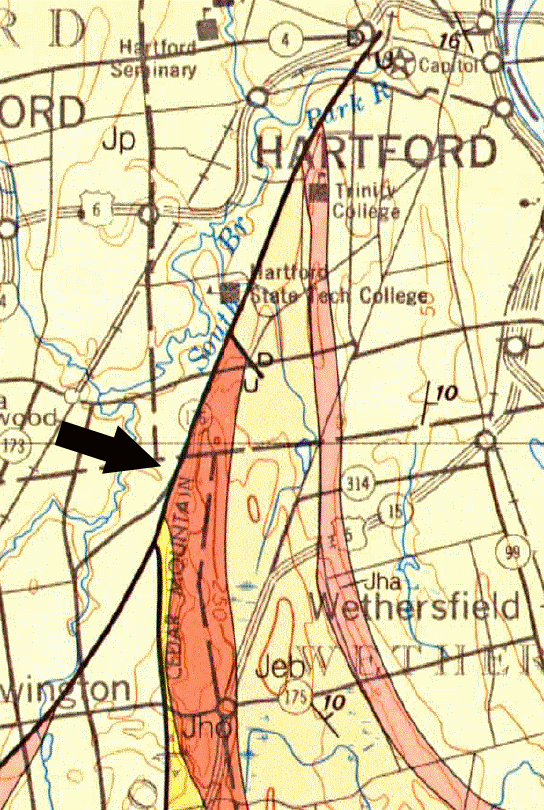
What’s the relationship of my bit of basalt to the events that doomed the Triassic world? The following two maps orient the formation from which I collected this basalt. Its history also helps to place it in proper context. The first map is a small portion of the 1985 Bedrock Geological Map of Connecticut prepared by the Connecticut Geological and Natural History Survey to which I’ve added an arrow (located in a slightly different place than it was in my earlier post) pointing to the location of where my basalt was collected (on the edge of Cedar Mountain). The reddish orange area on the map (labeled Jho) marks Jurassic Holyoke basalt. As already noted, this basalt is dated just after the end of the Triassic.
This second map is from Trap Rock Ridges of Connecticut and provides a close-up look at the igneous features of Connecticut’s Central Valley (part of the Hartford Basin). (Lewis, 2013, Figure 5.) The little brownish line numbered 6 is Cedar Mountain.

In the Trap Rock Ridges of Connecticut, geologist Ralph S. Lewis’ chapter provides a succinct and accessible description of the geological story behind these ridges, nicely inserting my piece of basalt into part of the larger geological picture. (Lewis, 2013.) What follows is my very brief summary of the aspects of the story he tells relevant to this post.
The original tectonic forces moving east and west that pushed Eurasia, Africa, and the Americas together, creating Pangea, generated mountain ranges that ran (and run) north/south. As the super continent began to break apart during the Triassic, those forces reversed course, pulling the land apart, creating rifts that paralleled the mountain ranges. In Connecticut’s Central Valley, the developing rift valley acquired sediment from the weathering and eroding metamorphic rock on its eastern and western borders. As expansion continued, magma rose through faults and fractures, intruding into, or extruding over top of, the sedimentary rock in the rift valley. Periods of sedimentary deposit were interspersed with three major extrusive lava flows: Talcott Basalt, Holyoke Basalt, and Hampden Basalt. Of these, the Holyoke Basalt was the largest.
Let me expand on Lewis and focus on a critical part of the story (critical, at least, to this post). The Connecticut Central Valley lava flows were an extended part of the broader, protracted volcanic event that marked the rending of Pangea: the creation of the Central Atlantic Magmatic Province (CAMP). CAMP is a massive area composed of basaltic magmas that flowed over a 10 million square kilometer area of Pangea. (Marzoli, 2018, p. 91, 101.) The peak CAMP event straddled the boundary between the Triassic and Jurassic. As a result, CAMP is directly implicated in the End-Triassic mass extinction. As Marzoli and colleagues write, “There is now general consensus in the scientific community that volcanic gases released by CAMP likely were the trigger mechanisms of the end-Triassic mass extinction and accompanying carbon cycle disruption.” (Marzoli, 2018, p. 114, cited sources omitted.)
Significantly, though the lava flows creating CAMP were concentrated in a roughly 1-million-year period (at the end of the Triassic), the geologic processes involved probably lasted for a full 10 million years. (Marzoli, 2018, p. 101.) Thus, though my basalt cannot be accused of killing the Triassic, it is, at least, an accessory after the fact.
I keep coming back to the real smoking gun in this and other mass extinctions, and it’s not the physical damage wrought by these lava flows (bad as it was) that bears the responsibility for ending worlds. Rather, the lethal weapon was “the volcanic gases released during the tectonic mayhem.” (Brannen, 2017, p. 157.) And, foremost among those gases? Carbon dioxide. Seems unsettlingly familiar, given what we’re doing to our current atmosphere. As Brannen observes, of the death of the Triassic world:
Though it wasn’t nearly as extreme as the End-Permian, the End-Triassic mass extinction seems to have been a sort of Great Dying Jr., with huge injections of carbon into the atmosphere from volcanoes and a lethal super-greenhouse as the result. But the End-Triassic mass extinction might also serve as a gruesome template of sorts for our next few centuries. (Brannen, 2017, p. 159, emphasis added.)
For me, that sobering thought infuses my basalt with its fundamental meaning. What a hellish world had come into being as this basalt was formed, a kind of world we seem to be inexorably recreating and bequeathing to our children’s children.
References
Brannen, Peter, The Ends of the World: Volcanic Apocalypses, Lethal Oceans, and Our Quest to Understand Earth’s Past Mass Extinctions, 2017.
Brusatte, Steve. The Rise and Reign of the Mammals: A New History, From the Shadow of the Dinosaurs to Us, 2022.
Lewis, Ralph S., Geology of the Trap Rock Ridges, a chapter in Penelope C. Sharp, et al., Bulletin No. 41: Trap Rock Ridges of Connecticut: Natural History and Land Use, Bulletins, Connecticut College Arboretum, 2013.
Marzoli, Andrea et al., Timing and Duration of the Central Atlantic Magmatic Province in the Newark and Culpeper Basins, Eastern U.S.A., Lithos, 2011.
Marzoli, Andrea et al., The Central Atlantic Magmatic Province (CAMP): A Review, chapter 4 in Tanner, Lawrence H., editor, The Late Triassic World: Earth in a Time of Transition, 2018.
Philpotts, Anthony R., The Holyoke Basalt, Its Source and Differentiation in a Thick Flood-Basalt Flow, Abstract, Annual Meeting of the Northeastern Section of The Geological Society of America, March 2012.
Philpotts, Anthony R., The Holyoke Basalt at the Tilcon Traprock Quarry, Chapter II of Peter M. LeTourneau and Margaret A. Thomas, editors, Traprocks, Tracks, and Brownstone: The Geology Paleontology, and History of World-Class Sites in the Connecticut Valley,, The Geological Society of Connecticut , Field Trip Guide Book No. 1, 2010.


 Posts
Posts


