Showing posts with label fossil collecting. Show all posts

Tuesday, April 21, 2026

Moveable Fossil Feasts

There are sites I consider moveable fossil feasts.  This is not in a Christian liturgical sense where the timing of a religious observation shifts from year to year.  Though a moveable fossil feast may, on occasion, exhibit some temporal impermanence, these feasts are much more about changing the locations of fossils.  Nothing divine about them, but, as a result of taking fossils from one site to another, likely more accessible, site, moveable fossil feasts offer collectors wonderful opportunities.

This terminology is mine alone.  I’ve never heard anyone refer to these sites in this fashion.  To be clear, I do not apply this term to places like the shoreline of the western Chesapeake Bay where fossils move as they erode from the Calvert Cliffs.  That process is natural.  In contrast, moveable fossil feast are human-made.  And, as such, the rewards they offer to fossil collectors are usually, but not always, a happy byproduct of the relocation of fossil-bearing sediment undertaken for some other purpose, such a beach replenishment.

This post offers brief descriptions of a few of the moveable fossil feasts with which I have some personal connection, either directly or indirectly, and one that I do not.  At the conclusion, I briefly highlight these sites' singular virtue and the challenging issues they raise.

North Myrtle Beach, South Carolina - A friend, sadly recently deceased, spent several weeks in different years vacationing with his wife at North Myrtle Beach, South Carolina.  They walked the beach a couple of times a day, outings timed with low tide.  As they went, they collected fossils – teeth, bones, shells – objects the waves had exposed on the beach.  A small sample from one year is pictured below.

These finds were often a stratigraphic and chronologic hodgepodge, a nightmare for identification.  Some came from the Pleistocene and Pliocene epochs (between 5 million to 11 thousand years ago), more from the Miocene period (23 to 5 million years ago) or the Cretaceous (143 to 66 million years ago).  Among the finds over the years were pieces of fossil turtle shells, ancient horse teeth, shark teeth, pieces of fossil sand dollars, and ammonite fragments.

My friend surmised this mixture resulted from efforts to replenish the beach, presumably with material dredged from offshore sedimentary layers from different time periods.  A competing or, perhaps, complementary explanation is that erosion of offshore sedimentary layers is the agent responsible for the fossils and their diversity.

C&D Canal (Reedy Point, Delaware) – I collected here twice many years ago.  It is a site created by the dumping of material dredged by Army Corps of Engineers in 1980 as it deepened the Chesapeake and Delaware (C&D) Canal.  The fossil-rich material hauled to, and deposited at, this site came from the Mt. Laurel Formation, dating from the Late Cretaceous. 

Here is a view of the location on one visit more than 15 years ago.

What was practiced here was mostly surface collecting, practitioners wandering through the overgrown and exposed landscape, eyes focused on the ground.  It was actually very easy hunting, though it took some time before the objectives of the searching came into view.  Most abundant (and obvious) were the orangey, long, pointed belemnites, the calcitic skeletal remains from the tails of the Cretaceous squid, Belemnitella americana.  Oyster shells (Exogyra) were also common.  Pictured below are some of these fossils.  An amateur’s rather old guide to the fossils from the Canal is suggestive of what could be found.

Is this site still there, still accessible?  I don’t know.  One source stated some four years ago, that the Army Corps of Engineers was planning to do more dredging and pile the dredged material on this site.  Unfortunately, this “new” material was slated to come from a formation lacking fossils.  Another source simply says it’s closed.  Such is the fate of, at least, this moveable fossil feast.  

Aurora Fossil Museum, Aurora, North Carolina – Located near the Lee Creek Mine, a phosphate surface mine that, when it was open to collectors, yielded stunningly beautiful fossils, particularly those from the megashark Otodus megalodon.  The various Lee Creek fossils come mostly came from the Pungo River (Lower Miocene) and the Yorktown (Early Pliocene) formations.  Not unexpectedly, the areas where we could collect, when we permitted into the open pit mine, were not pristine, not as they were originally laid down, but, rather, we needed to figure out which formations might have contributed to the areas in which we were collecting.  For me, at least, that was not always clear.

Now, I don’t consider the mine itself to have been a moveable fossil feast because collectors went to where the fossils originated, albeit in strata that were highly disturbed by the mining process.

No, the moveable fossil feasts, for me, are the spoil piles of material hauled from the mine and deposited outside the Aurora Fossil Museum in Aurora, North Carolina.  Purportedly, this material consists of tailings from the Pungo River formation which, even if true, does not locate these fossils within the various units that make up this formation. 

When I was last there – some 15 years ago – this was the view toward the spoil pile where I hunted a couple of times, once when a trip to the mine was cancelled at the very last minute and once after a successful hunt at the mine.

The museum has evolved greatly since then and, among other changes, now has two pits of material from the mine.

The finds were small, though relatively abundant; searching on one’s knees was rewarded.  Here is a sampling of what turned up on one of my hunts through the spoil piles.

This moveable fossil feast is wonderfully accessible, located in a small town with parking just a short stroll away.  It’s all rather domestic as attested to by the cat who oversaw my activities.  (The cat may have had other intentions for the sand of the fossil pit.)

Bradenton Beach, Florida – The same friend who enjoyed the moveable fossil feast at North Myrtle Beach was vacationing one year at Bradenton Beach when he came upon this scene in a parking lot serving the beach.


Never inclined to ignore the possibility that fossils might be had, he explored these huge mounds of gray, phosphatic sand and discovered a true wealth of shells, most in fantastic condition.  He spent much of his vacation climbing up and down this sandy landscape, gathering shells.

These were, indeed, fossil shells because he learned that the sand had been hauled to this location from an area quarry which he concluded was the SMR Mine in Sarasota, making these fossils Pliocene, about 3.6 to 3.0 million years old.  Here are three beautiful specimens I obtained from him.

Though this moveable fossil feast was extremely accessible (in a parking lot, of all places), my friend searched these sandy hills quite feverishly because all of this material was slated shortly to be crushed to pave the parking lot.

Rotterdam Harbor, The Netherlands – This last moveable fossil feast, international in nature, was featured in Nina Siegal’s article titled On the Hunt for Mammoths which appeared on November 17, 2025 in the online version of The New York Times (print edition ran the article on November 19, 2025).  

This feast has features reflected in some of the descriptions I’ve already provided of such sites, but there is a remarkable attribute that sets this one apart, prompting me to think – “The Dutch know how to do this.”

In the article, Siegal describes how people are hunting for fossils along at the Maasvlakte 2 beach, on the harbor shoreline in Rotterdam, benefitting from a beach reclamation project – no, more like a beach construction project.  This beach is wholly constructed of sediment dredged from the sea floor of the North Sea, sediment roughly 2.5 million to 11,700 years old.  This sediment comes from what once was a steppe where megafauna animals lived.  As a result, the material used to build the beach contains the fossil remains of many land animals, such as woolly mammoths, woolly rhinos, and giant horses.  Sprinkled among these are fossils from invertebrates including sharks.

Now, here’s where it gets truly amazing.  What sets this moveable fossil feast apart from the others I’ve described so far is the incredibly well organized scientific support for the amateur fossil collectors who scour the beach.  In The Netherlands, these fossil hunters are permitted to keep their finds, but they are also encouraged to register them with the online Oervondschecker (“Primal Find Checker”), initiated by the Port of Rotterdam Authority and now maintained by the Naturalis Biodiversity Center.  (The default language on the site is Dutch, so having a browser translate the text is useful for some of us.)  As the website states:  “Every notification will be reviewed within a few days by an expert.  A find gets a provisional determination and an (estimated) time determination.”  Marvelous.

How does Naturalis do that?  Each collector seeking to register a find is asked to submit pictures of it with the precise GPS location of where it was found (ah, the wonders of the smart phone) or, at a minimum, they are advised to use the app to locate the find on its associated map of the beach.  As the Naturalis Biodiversity Center explains on the website, the dredging operations were “accurately tracked,” including the depths at which the sand was “sucked up” during each trip.  Data on the geologic origins of the individual layers of sand at the seabed in the North Sea feed into the Naturalis calculations.  Further, where the dredged sand was deposited on the beach was also meticulously followed.  As a result, the general provenience of a find can be determined and used to estimate its age.  That is truly amazing.

In conclusion, my descriptions of these few moveable fossil feasts suggest a cardinal virtue as well as a couple of sins associated with them.  The single most important positive attribute of these sites is that, as a result of human intervention, fossil-rich sediment has been moved from one location to another, a place that is typically much more accessible and convenient for collecting.  Fossil hunting at them can be easy – e.g., going through the Aurora Fossil Museum fossil pits or walking the beach at the Rotterdam Harbor.

On the other side of the ledger, these sites have certain downsides.  Having separated sediment from their original location, the makers of these sites (with the important exception of the Rotterdam Harbor beach) sever the ties between the fossils and the geological strata where they were originally found.  Identification and age determination can be difficult, and sometimes, though not always, impossible – the finds on North Myrtle Beach, for example, are a challenge.  Another key negative attribute is that they can be transient, sometimes offering only a limited opening for collecting - the material in the Bradenton Beach parking lot is a striking case in point.

Still, they are a wonderful phenomenon and taking advantage of them, no matter the challenges, is a delight.

Saturday, January 22, 2022

A Gray Whale Skeleton: Stories With Stories

What happened was just this:  I got hooked on the story.

For the first time in my life, I became actively interested in a book.  Me the sports fanatic, me the game freak, me the only ten-year-old in Illinois with a hate on for the alphabet wanted to know what happened next.

William Goldman, The Princess Bride:  S. Morgenstern’s Classic Tale of True Love and High Adventure, edition copyrighted 2003, p. 9.

For the most part, the stories we tell are expected to have a beginning, middle, and end.  We move through them (at least at first reading or telling) wanting to know what happened next.  An end may be reached because problems or situations are resolved.  At that juncture, there is no next.  But quite clearly that’s not sufficient for many of us, witness the endless stream of sequels in multi-volume novels or movies.  Then there is that interest, perhaps demand is better, for prequels.  We want to know what happened before.  All of which leaves me wondering where one story begins or ends, and another story begins or ends.  Are we in the midst of stories with stories?  I think these observation aren’t just restricted to fictional stories.  This post is about a true story with stories.

In late 2021, the most complete gray whale (Eschrichtius robustus) skeleton ever found was transported from the collections of the University of North Carolina Wilmington’s Department of Biology and Marine Biology to those of the Smithsonian’s National Museum of Natural History.  In a multi-day process, experts from the Museum and the University worked on preparing the 42 bones of this juvenile specimen (including the skull, jaws, and vertebrae) for the trip (bubble wrap figured prominently in the effort).  The bones were carefully packed into a van and then (as carefully) driven up the East Coast to the Museum Support Center in Maryland.  Transferring the bones into the Support Center’s whale warehouse was another major undertaking.  (Unless otherwise noted, information presented in this post comes from the first two sources cited in the reference list at the end of this post.)

Pictures of the skeleton by UNCW’s Jeff Jankowski are included here with the generous permission of UNCW.  The first shows Dr. David Webster, Associate Dean of College of Arts and Sciences (CAS), with key elements of the skeleton.  The second of preparation for the move shows Dr. Webster (far right), Bill Crews (Facilities Coordinator CAS, center background), with Museum specialists David Bohaska (left) and Peter Kroehler (center right).


While the unique completeness of the skeleton is an important scientific draw for this specimen, that it is the skeleton of a gray whale is another critical attribute.  This skeleton is estimated to be roughly 1,000 years old, while the gray whale population that inhabited the Atlantic has been extinct for at least some 300 years with gray whales confined today to the North Pacific Ocean (reference #3, p. 502).  (Their range may be expanding and some may be entering the Atlantic once more.)  This skeleton may offer insights into the environment within which this individual lived in the Atlantic.  As Dr. Nicholas Pyenson, Curator of Fossil Marine Mammals at the Natural History Museum, said of this skeleton, “Specimens like these, tie to place and time.  They tell us how the world once was.” (reference #2)

This quick story of the move of a juvenile gray whale skeleton from a university campus in North Carolina to Smithsonian facilities in Maryland begs for some clarification.  A brief comment on what happens next:  the skeleton apparently will not go on display but will be stored by the Natural History Museum and made available for scientific research in the future.

More to the point and of more interest:  what happened before?  Here the stories (the prequel stories) become more complicated and somewhat fuzzy.

UNCW held the skeleton’s bones in its collections for perhaps three decades.  Apparently, for much of that time it was unclear what species of whale was represented here.  There were some humpback whale bones in the mix of bones but those turned out to be “red herrings.”  The skeleton was ultimately identified as coming from the extinct Atlantic gray whale, an identification later confirmed by Nicholas Pyenson of the National Museum of Natural History.  That identification prompted the negotiations that led to the donation by UNCW of the skeleton.

What happened before that?  How did UNCW come to hold this skeleton in the first place?  David Webster, UNCW dean, recounted that local residents Rita and Tom McCabe approached the university to see if it would be interested in the donation of some whale bones that were, at the time, being stored in the McCabe’s garage.  When the university accepted the donation, a transfer occurred, one markedly different from the one last year when the bones traveled to the Smithsonian.  As Webster recalls, “They [the McCabes] drove a small Chevy S10 pickup truck to campus, and they had bones hanging out all over the place.”  (Reference #1). 

And what happened before that?  Now things get very interesting and decidedly vague.  The news articles that appeared in the last couple of months about this gray whale skeleton donation are actually the reason this story or stories have proven irresistible to me.  The articles are singularly vague about how these bones came to light so they could be socked away in the McCabe garage.  Here’s how the UNCW news article described that process:

When Rita and Tom McCabe started collecting shells, fossils, and treasures like megalodon teeth during leisurely walks along the shorelines of West Onslow Beach [North Carolina] in the 1970s, they gradually found a variety of larger bones that they kept stored in their garage for years.  (Reference #1)

News pieces like this may be recounting what there is known to tell, but a description like this triggers a curious response in a fossil collector, well, this one, at least.  “Leisurely” beachcombing over some period of time seems highly unlikely to enable someone to build a collection of 42 bones from a single whale skeleton (including articulated vertebrae, no less).  Consider the size and weight of the bones depicted in the photographs above, as well as the number of people involved in packing and transporting the bones from the university to the museum.  Does one “gradually find” bones of this magnitude and in these numbers on a beach and carry them easily home?

The storyline at this point might do with an alternative narrative, one that salutes the McCabes’ foresight and dedication, but adjusts the account of what they did.  It seems more likely to me that the discovery and collecting of these bones happened in some sustained fashion and involved a substantial amount of time and energy on the part of the McCabes and anyone else who may have helped in the recovery from the beach.  This version of the story finds some support from the fact that Rita McCabe, and apparently to a lesser extent, Tom McCabe were devoted fossil hunters.  They led collecting trips to West Onslow Beach for the North Carolina Fossil Club.  (Reference #5)  A loving portrait of Rita McCabe on her death written by a son recounted that she was known as “Mrs. Onslow Beach.”  She started by collecting shells but was drawn to the fossils.  “Within years she would harvest every bit of information about the tens of thousands of fossils she would find on Onslow Beach.”  (Reference #6)

And what about even before that?  How did the skeleton come to be somewhere on the West Onslow Beach?  As noted, the skeleton is an estimated 1,000 years old.  Its history from its death to the discovery of its skeleton is unknowable in nearly all respects.  But given that this is the skeleton of a juvenile gray whale and the condition of some of its bones, a few things are likely.  Extant gray whales undertake long distance migrations from southern breeding grounds to northern feeding grounds.  Appropriately, the skeleton’s trip from North Carolina to Maryland probably paralleled a part of the marine migrations that the juvenile might have made a couple of times with other gray whales from breeding grounds perhaps as far south as the waters off Jupiter Island, Florida, to feeding grounds as far north as the depths off Southampton, New York.  (reference #3, p. 507)  Thus, it is possible this whale died during a migration along the East Coast.  Further, it is conceivable that, after its body washed ashore, it was butchered by local Native Americans.  Cut marks on some of the bones suggest that chapter of the story.

Onslow Beach deserves a chapter in this story or story of its own.  The beach is part of the Marine Corps’ Camp Lejeune.  Tom McCabe was a Marine, so there’s that connection.  As for the geological and paleontological aspects of the beach and its myriad fossils, I came across an article about fossil collecting on the beach that ran in the Camp Lejeune newspaper The Globe on November 2, 2006 (reference #7).  Relying on observations by North Carolina Fossil Club members, the article posits that that the beach’s fossils come from areas that were near-shore in the early part of the Miocene, as well as from inland sediments of younger ages, hence the wide range in ages of the fossils found here.  Of particular interest for this post, the article begins:

Fifty years ago, Rita McCabe didn’t even know what a sand-dollar looked like.  Today, the Jacksonville [North Carolina] resident is the owner of a considerable fossil collection which includes mastodon teeth, mammoth molars, whale vertebrae and shark’s teeth of every imaginable size. . . .  The Smithsonian Institute [sic] has taken an interest in her collection and sent representative to look at her specimens, which she keeps carefully tucked away in her home.

Yes, happily, there are stories with stories.

References

1) Krissy Vick, UNCW Department of Biology and Marine Biology Gifts Extinct Gray Whale Specimen to Smithsonian, UNCW News, December 21, 2021.

2) Alia N. Payne, A Gray Whale Makes its Way to the Smithsonian, Smithsonian Ocean, December 2021.

3) Scott E. Noakes, et al., Late Pleistocene Gray Whales (Eschrichtius robustus) Offshore Georgia, U.S.A., and the Antiquity of Gray Whale Migration in the North Atlantic Ocean, Paleogeography, Paleoclimatology, Palaeoecology, Volume 392, 2013.

4) Elly Cosgrove, From UNCW to the Smithsonian:  The Decade-Long Journey of Extinct Gray Whale Bones, WECT News, January 17, 2022.  There is an excellent video associated with this news story.

5) North Carolina Fossil Club, Janus, Number 1, 1994, p. 2.

6) North Carolina Fossil Club, Janus, Number 1, 2014, p. 2.

7) Amy Segreti, Going to the Beach?  Bring a Bag to Carry the Ice Age Mammal Fossils, The Globe, November 2, 2006.


Monday, January 27, 2020

A Gatherer on the Foreshore of the Thames ~ A Review of Lara Maiklem’s Mudlarking

Recently I was asked for advice about searching for fossil shark teeth in Maryland.  I described sites on the western shore of the Chesapeake Bay and on the Potomac River, and added a crucial bit of information:  these sites are on tidal waters.  Of most immediate concern, the maximum exposure of areas to be explored for fossils occurs at low tide, while, at high tide, beaches disappear under water and the unwary fossil hunter may be trapped against cliffside.  But, even more fundamentally, the entire collecting enterprise here has a particular nature because of the tides, aided by the weather.  The tides are a constant companion for the collector, a companion whose demeanor must be attended to carefully.  Areas for collecting are in constant change; beaches expand and contract; piles of debris, clumps of algae, and stray dead fish confront the collector one day only to be gone the next day.  Fossils appear and disappear thanks to the tides.  I have often referred to the fossil gods who may bless an outing with an abundance of finds, or condemn it to hours of unproductive, painful exploration.  Are the tides here the agents of the fossil gods or the gods themselves?

Lara Maiklem knows of what I write, even though her venue is the Thames as it flows through London and her quarry archaeological.  Her stunning book Mudlarking:  Lost and Found on the River Thames (2019) describes her experiences combing the foreshore of the Thames for lost objects from the many communities that have inhabited these shores for millennia.


The book is a heady and compelling combination of social and political history (we are talking about London, after all), adventure (searching the Thames foreshore is not without its dangers), and memoir (her family history and her own history are gently introduced).  With a writing style that is graceful and warm, Maiklem strikes no false notes in her account of her mudlarking on the Thames.  The book is a wonder.

I should start where she starts, with a definition of mudlark.  It’s both a noun and a verb.  A mudlark, according to the Oxford English Dictionary (2nd definition, colloquial) is:
A person who scavenges for usable debris in the tidal mud of a river, harbour, etc.
To mudlark is to engage in such activity.  I particularly like the OED’s etymology of the term, “probably humorously after skylark.”  Mudlarking is, in fact, a very old activity; the earliest use cited by the OED is from the late 18th century.

In the book, Maiklem traces the Thames from west to east as it courses its way to and through London.  The river is, she notes, “England’s longest archaeological landscape and thousands of the objects that fill our museums have come from its foreshore.”  (p. 47)  It’s not just the obvious things that the river preserves, such as swords and spoons, but its anerobic mud holds soft material, such as wood and leather, in suspended animation.  The human presence along its shores goes way, way back; indeed, Maiklem’s oldest find is a worked Mesolithic flint.  Actually, the human presence on the river may be as much responsible for what mudlarks find.  For ages, people have worked on the river and traveled on the river, losing cargo and personal items to it in the process.

Her finds from the length of the river as it passes through London are a bewildering array of objects, most centuries old, ranging from coins to knives to cannon balls, toys to dice, rings to dress pins, shoes to pipes, glass jars to pottery, and on and on.  For many of the different kinds of objects that a mudlark collects from the Thames, she provides a succinct overview of how they were made and used.  Yet there is much that is not collected, most of it in the modern detritus that fouls the foreshore with such things as wet wipes, plastic teeth flossers, disposable razors, toothpaste tubes, and so on.  Sadly, much of the modern refuse is plastic which will, in essence, be with us forever.

Maiklem frames the book around key sections of the river’s foreshore, devoting individual chapters to each:  beginning with the Tidal Head in the west, and then moving to Hammersmith, Vauxhall, Trig Lane, Bankside, Queenhithe, London Bridge, Tower Beach, Rotherhithe, Wapping, Greenwich, Tilbury, and ending at the Estuary in the east.  In each, we learn more about mudlarking, a bit more about Maiklem herself, and much about the shoreline:  what it’s like now, what it was centuries ago, what might be found in each section, and why.  For the last, she offers glimpses of the history of an area, describing who lived there and how this influenced what the river offers up today.  Her collecting impulse comes not from the potential monetary value of any particular find.  Rather, it’s the human story behind the object that draws her in, leading her to speculate as to who might have used it and how it might have come to be lost and then washed onto the foreshore for her to find.

As she draws out the narrative behind found objects, she weaves in her own personal story.  For instance, in the chapter on Greenwich (perhaps one of the most personal in the book) she describes how she came to live there for some time and how, finding solace walking the path along the river, she was slowly drawn to the shoreline and became aware of what the mud held.  She starting collecting and then, upon reading an article about mudlarking, discovered she’d become a mudlark.  Her story in this chapter touches on her marriage, the birth of twins, the death of her father, and her attraction to things Tudor, an outgrowth of her childhood living in a 16th century farmhouse.

But, even as she reveals these aspects of her life story, the foreshore remains this chapter’s focus.  It’s at Greenwich that Henry VII in the late 1400s replaced a large house dating back to the early medieval period with a palace that, in time, became Henry VIII’s primary royal residence.  Thus Tudor history permeates the area, including what is to be found combing the foreshore:
The objects that are hidden in the mud at Greenwich fill in the details that are missing from the history books and brings the world of the Tudor palace to life.  The foreshore here is like one large midden, a palatial version of the one in front of the house where I grew up, and in which are buried the ordinary lives behind the lavish parties. (p. 238)
With that, she introduces the reader to what the river gives up at this place which reflects the life that palace residents lived, particularly those aspects involving food:  what was prepared, and the implements used in its preparation and in its consumption.  The mud disgorges pieces of pottery from pots used in the palace kitchen, myriad bones from the animals whose flesh was cooked and eaten by palace residents, remnants of the fruit and nuts they consumed, knife handles made of bone, ivory, and wood, and spoons of bone and pewter.

It is when Maiklem deconstructs the process of mudlarking that I find strong connections to the kind of fossil collecting that I do along tidal waters.  I began this post with the tides and how they hold the collector in thrall.  She’s no stranger to that power.
I am obsessed with the incessant rise and fall of the water.  For years my spare time has been controlled by the river’s ebb and flow, and the consequent covering and uncovering of the foreshore. . . .  I have carefully arranged meetings and appointments according to the tides, and conspired to meet friends near the river so that I can steal down to the foreshore before the water comes in and after it’s flowed out. . . . I have lied, cajoled and manipulated to get time by the river.  (p. 3)
She draws a striking distinction between the gatherer mudlark and the hunter mudlark.  The former takes what the river offers up, the latter attacks the river’s foreshore with implements to uncover objects the river has not yet chosen to reveal.  For the gatherer, time on the river is what’s of most value; for the hunter, it’s often the value of the objects found, in terms of the money or status they might bring.  Though I’ve indulged in both approaches in my fossil collecting, I agree with her that, when my interaction with beach is at its gentlest, casting just my eyes upon it, the whole process is at its most meditative.  That’s when I am lost in the flow (a mental state I’ve written about several times, including here).

Not surprisingly, she recognizes the importance of acquiring a “search image” (though she doesn’t use that phrase) in order to distinguish one’s quarry from the surface of the shore.  A search image is critical for fossil collecting and mudlarking.  In the chapter on the London Bridge area, she recounts how, when she was a child, her mother would take her on nature walks, showing her how to observe and pay attention to details of the environment around her.  Still, despite her “keen eye,” Maiklem notes that finding things along the shoreline did not come easily.
It took me a lot of time, practice and patience before I started spotting objects lurking in the Thames mud.  Mudlarks call this ‘getting your eye in’ and the mistake many people make is looking too hard.  Mudlarking is a stubborn skill and the harder you look the less likely you are to be successful.  The key to spotting objects on the foreshore is simply to relax and look through the surface.  (p. 140)
She makes that point forcefully in her chapter on Trig Lane which presents a delightful discussion of handmade metal pins, her “favourite kinds of treasure.”  Maiklem describes how they were made (from roughly 1400 to the early 1880s when machine production took over) and used.  Though the foreshore abounds in handmade pins, at first they eluded her.
It took me a year or so to find my first one, but now I’ve got my eye in for them I see them everywhere. . . .  In some areas the mud bristles with them and I search gingerly to avoid being pricked.  (p. 87)  
The dangers of collecting along shorelines are broadly similar for those in search of fossils in the sites I have frequented and those looking for lost objects along the Thames’ foreshore.  It’s risky to search alone in many places.  The waters themselves can threaten the collector with an appalling mixture of toxic materials (though the urban mixture along the Thames seems worse than what I’m used to as it includes medical waste, condoms, and syringes, among other delightful things).  Water-borne illness can strike the collector.  Yes, this can be a nasty business, but the mudlark and the fossil collector persist because the psychic rewards outweigh the risks.

At the end of the book, Maiklem sums up the journey the reader has taken with her from the east to west.  She writes as though she’s standing on the edge of the estuary where the Thames mixes into the North Sea and is visualizing the tide rushing in from the sea, moving west toward London, swelling the river and covering what is held by the mud and muck of the foreshore.  It is here that she beautifully captures in a finely wrought simile what the Thames must be for mudlarks:
The river is like a great khaki snake-dragon, smoothing and stroking its treasures, hiding them in its coils.  (p. 293)

Tuesday, January 30, 2018

Fossil Hunting in that Foreign Country of Old Age

A man I know recently dropped dead under circumstances that prompted some to observe that at least he was doing something he loved.  He didn’t die while in the field searching for fossils, an activity about which he was also passionate, though that specific thought had, in fact, crossed his mind.  A decade ago, in a piece describing a fossil hunt, he wondered how much longer he’d be able to deal with the demands of tracking down fossils given that he was then in his late 50s, and this particular hunt had proven particularly taxing.  Still, he posited, if his demise were to come on some future hunt, it would be “a wonderful way to go.”

His death has me thinking about how to carry on fossil hunting into old age because I want to skip the part where I succumb while climbing over a fallen tree to reach some secluded stretch of cliffside beach or cascading head over heels down a rocky hill, a trilobite tumbling before me, just out of reach.  As I venture into my old age, I’ve already begun a transition in how I collect and work with fossils.  There was a time that I would blithely jump into my car, head alone to some isolated beach or overgrown road cut, and spend the day in pursuit of yet another fossil shell or tooth or . . . ., all done with few thoughts about the risks being taken.  I don’t think that even then I would have wanted to reach my end out there, and I certainly don’t want to now.  So I have been modifying how I pursue this avocation.

At one level, the transition in my collecting has been a matter of a change in the sheer magnitude of what’s being hunted.  At one stage, I was thrilled to load up my knapsack with a clutch of large, heavy fossils, some in matrix, some not.  Here’s an example of such specimens; I hauled this juvenile whale vertebra back from the Lee Creek phosphate mine (and the Miocene Epoch).


But these days, as my posts on this blog in the last few years certainly document, I’ve gone small, microscopically small.  Over time the proportion of the fossil specimens in my collection that is only enjoyed under the microscope has grown until now the vast majority of my fossils are just one or two millimeters in length or often smaller.  To wit, roughly a hundred Pliocene Epoch snail shells from the Tamiami Formation in Florida populate this slide.


What has this shrinkage meant for my collecting?  Well, these days I hardly ever venture out in crappy weather in search of fossils.  No more risking hypothermia to be the only person at a site when freezing rain is falling.  No more sallying forth carrying loads of water to stay hydrated in the searing summer sun.  No, much of my fossil hunting can be done sitting at home, in my pajamas, listening to music, sipping tea, while peering through a microscope.  The hunt has come to me and under very controlled circumstances.  Indeed, much of the matrix that I have work through in search of microscopic fossils is given to me, such as that which was serendipitously found inside a fossil shell presented to me by a friend or dug up by a traveling spouse on a beach in Scotland.  By going small, I think I’ve gone safer.  That doesn’t mean, of course, that I won’t collapse at my desk, knocking the scope and slides to the floor, crashing into my computer, while the strains of the cryptic and dark song Hollow Talk by Choir of Young Believers continue to drift from desktop speakers.  No, but it may mean a boost in my chances of enjoying fossils for awhile longer.

And isn’t that the point?  Responding to the inevitable limitations of age by accommodation while still maintaining as long as possible some aspect of the enjoyment that this activity or any other might provide – that seems to me to be a worthy goal.  Sure my productivity in this endeavor will diminish and maybe even disappear entirely, but it doesn’t make it any less worthwhile to me or those with whom I might encourage by sharing my enthusiasm.

In a provocative article titled Why I Hope to Die at 75 (The Atlantic, October, 2014), oncologist Ezekiel J. Emanuel laid out his argument for cashing in at 75.  Basically it boils down to his belief that were he to reach age 75 in reasonably good physical and mental health, it would clearly all be downhill from then until his death.  Upon reaching this benchmark age, he will reject any medical intervention intended to prolong life, even to the point of skipping an annual flu shot.

Sure, he notes, life expectancy has increased in the past century and, in many countries, it extends beyond 75.  But once the gains from reducing infant mortality and the ravages of infections were achieved, all of the growth in longevity has come from increasing the duration of old age.  And, he explains, our old age has become increasingly the province of disabilities.  He walks the reader through the ravages that age will visit upon our bodies and it’s not a pretty picture.  Some fortunate folks will escape most of these slings and arrows, but most will not.  The decline in mental ability is inevitable and in some cases catastrophic (Alzheimer’s affects a third of all seniors over the age 85).  This is a foreign country of the truly aged that Emanuel has no desire to visit. It certainly helped that he was 57 when he wrote the article, giving him a full 18 years until he would reach his expiration date.

Frankly, I think what concerns him most about living beyond age 75 is that his productivity will diminish, that he will no longer be able to contribute to his life’s work or certainly not as much as he did as a young professional.  He writes, “But the fact is that by 75, creativity, originality, and productivity are pretty much gone for the vast, vast majority of us.”  As for the other kinds of contributions seniors might make, Emanuel is dismissive, apparently because they aren’t up to the standard he applied previously in his life; he is ultimately, I think, most concerned about one aspect of living beyond 75:  “the constricting of our ambitions and expectations.”  There’s a disapproving tone when he writes about his own father who had a heart attack at age 77 which spelled an end to the vigorous, productive life he’d been leading.  In the decade since, his father has slowed down, still swimming, reading, etc., but, “[a]lthough he didn’t die from the heart attack, no one would say he is living a vibrant life.”  Emanuel notes (I heard this in a dismissive tone), “Despite this, he also said he was happy.”  It boils down, apparently, to a calculus about “whether our consumption is worth our contribution” which points to age 75 as when it’s probably not.

I reject Emanuel’s position because I think it’s born from the demands of a Type A personality who has, and is, leading a professional life that is vastly productive and fulfilling, a personality who cannot envision being anything less than, dare I say it, a super star.  The diminution of his abilities would apparently be a fatal blow to his sense of self worth.

And none of that is me.  I don’t have the drive to be as productive as I once was (even that productivity was a mere shadow of Emanuel’s) and what I find most fulfilling (something true even back in my middle age) is in my personal life – family and avocations.  So, though I might not make it to 75 or beyond, I have found some balance and peace in that constricting of ambition and expectations that has already accompanied me a bit in the aging process.  I’m okay with consuming more than I’m contributing.  Selfish of me I know, but there are still things I want to do even if they don’t balance the ledger.

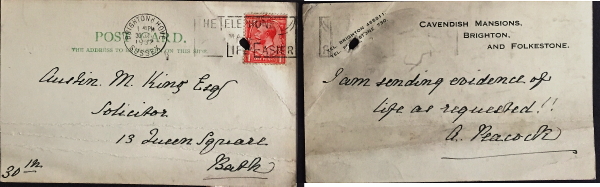
So perhaps I’m the second coming of A. J. E. Peacock, an early 20th century Brit, who seems to have escaped the privacy-invading reach of the Internet.  I know nothing about him except what I recount here.  While on the hunt for stamps from the King George V period, I came across two postcards that Peacock wrote to his solicitor, Austin M. King (1876 – 1944; there are traces of King on the web) in 1931 and 1932.  The first is a postcard from the Devonshire House Hotel, London (it was a residential hotel I believe), and the second is from Cavendish Mansions in Brighton and Folkestone, a resort area south of London.  The holes in the stamps are clearly the work of some clerk who smashed each postcard onto a bill spike.  But it’s the messages that Peacock wrote in his spidery hand and sent to his solicitor that so amuse and intrigue me.  I and others have speculated, sometime wildly, about the reasons for the messages, the most prosaic being a financial trust that demanded them annually.  I particularly love the exclamation points!!


I’ve taken this to heart.  Whatever I do to accommodate the vicissitudes of aging in the future, consider it as simply “evidence of life!”

Friday, February 25, 2011

The Shuffle of Things: A Museum, A Mummy, and A Cemetery

In describing the three essential possessions of a learned man, Francis Bacon identified a good library, an expansive garden, and, for the third,
a goodly, huge cabinet, wherein whatsoever the hand of many by exquisite art or engine has made rare in stuff, form or motion; whatsoever singularity, change, and the shuffle of things hath produced; whatsoever Nature has wrought in things that want life and may be kept; shall be sorted and included.
 ~ as quoted in An American Cabinet of Curiosities:  Thomas Jefferson’s “Indian Hall” at Monticello, by Joyce Henri Robinson, in Acts of Possession:  Collecting in America, 2003, p. 17 (link provided below in list of sources).


The growing pile of magazines destined for recycling testifies to my self-restraint.  Many year-old issues meet their fate, victims of too little storage space and, for those that are largely unread, of too little time.  On this day, for awhile at least, I avoid the ever present trap in this process, but then an article catches my eye and the whole effort halts abruptly as I sit back and begin to read.

The Fall 2010 issue of Middlebury Magazine ran an article (a pictorial essay actually) titled Tales from the Crypt; it offered a glimpse of West Cemetery which abuts the campus of Middlebury College (my fair alma mater).  History professor Jim Ralph wrote the brief text, Mario Morgado took the evocative photographs.  I later went to the magazine’s website for two video essays – one of a tour of the cemetery with audio commentary by Ralph , the other featuring Morgado describing the pinhole camera “technology” used in the project.

How had I missed this piece when the issue arrived in the mail?  I certainly must have done my usual systematic “page-through” the magazine from back to front (the reverse order makes sense to me because I reach the classnotes and the obituaries sooner that way), but, somehow, I’d failed to spot it.  So, on this day of cleanup chores, I was derailed and had a West Cemetery reverie.

On many days during my freshman year at college, on my way to the gym, I walked through West Cemetery, just down a hill to the south behind several of the dormitories.  A peaceful place of worn markers, many askew, the sweeping lawns punctuated with sudden stands of markers and monuments and deciduous trees (perhaps maples, I don’t remember, though colors there in the fall come back to me).  The whole surrounded by pine trees, a gravel road ran through it.


Over my years at the college, the main attraction in the cemetery for me and a few of my fellow classmates became a particular gravesite, the final resting place of the ashes of a mummy.

How had it come to be here?  Nineteenth century Americans gathered, collected, studied, and displayed objects, commonplace things and curiosities, often from the natural or ancient worlds.  Whether they did so more than their 18th century predecessors or more contemporary successors, I don’t know, but I suspect that collecting, particularly focused on natural history, was a more widespread phenomenon during that century than it was before or after.  Many in those years were busy assembling their cabinets of curiosities.  In many cases, these were literally cabinets; in others, a place or room in the home in which to keep a collection.  Furniture was designed specifically to hold, protect, and display those objects.  In the front hallways or parlors of homes, these cabinets and displays might welcome and instruct visitors.

The impulses behind this collecting were many, among them:  theological (finding God in nature, reflecting the divine order), nationalist (disproving the Old World contention that, in the New World, Nature was dissipated), educational (reflecting the expanding reach of learning within the society and recognition of its importance), scientific (contributing to the nascent sciences, still open to amateurs, through the gathering and describing of objects from nature), or historical (as the pace of change accelerated, seeking to hang on to evidence of the virtues and glory of the past).  (At the end of this post is a selected list of references.)

Henry Sheldon (1821-1907) lived in Middlebury, Vermont, playing music, serving as town clerk, and, most of all, collecting on a grand scale with an undiscriminating eye – nearly everything was worthy and fair game.  As Jan Albers, executive director of the Henry Sheldon Museum (Middlebury, Vermont) has written:
Henry’s first real love was a Diocletian coin he bought for one dollar in 1875.  The thrill of holding a tiny piece of ancient Rome in his hand was almost overwhelming.  He was determined to collect more such interesting objects.  He bought coin after coin, and then turned to other categories:  books, pamphlets, letters, diaries, autographs, clocks, guns, furniture, paintings, household objects, agricultural implements and more.  (Salisbury Man Founded Sheldon Museum 125 Years Ago, article dated June, 2009, on the Sheldon Museum website.)
Albers noted that Sheldon’s focus ultimately narrowed as his collecting shifted to the early, pioneer history of his region and town.

In 1882, he and a friend bought a mansion near the center of the village of Middlebury.  This structure, dating from 1829, was built by marble quarry owners Eben Judd and his son-in-law Lebbeus Harris.  The new owners divided up the structure, Henry Sheldon taking half of the second floor for his living quarters and installing his growing collection on the third floor.

Though Sheldon shared in the collecting urge of the 19th century, he took a step that most Americans did not and opened a museum in 1884, under an act of incorporation passed by the state legislature.  Still, opening a museum in Middlebury was in keeping with a phenomenon of the age – community after community, large and small, took to hosting museums, one of an array of “urban cultural institutions” that reflected towns’ civic pride and a “genuine concern to live as civilized people.”  (Thomas Bender, Science and the Culture of American Communities:  The Nineteenth Century, History of Education Quarterly, 1976.)

Though, for me, mystery continues to cloak the story, this much is clear, the mummy’s gravesite in the West Cemetery came to be because of Henry Sheldon’s drive to collect.  The highlights of the story I’ve recounted below may well all be true.  I’ve relied for the most part on the account by Helen Husher in A View from Vermont:  Everyday Life in America (2004) (available in part at Google Books), and I’ve also drawn some details from Curious New England: The Unconventional Traveler's Guide to Eccentric Destinations by Joseph A. Citro and Diane E. Foulds (2004) (available in part at Google Books),

Sheldon bought the more than 3,500 year old mummy of a royal Egyptian child for $10 in December, 1886, working the price down from $20 because the mummy was dramatically showing its age.  The mummy may have been briefly displayed in the museum, but, because of its condition, it was probably stashed away in the attic soon after it arrived.  Sheldon never knew much about what he had purchased, and even what he thought he knew was apparently wrong.  After the mummy was rediscovered among the museum’s holdings in 1945, the writing on the plank on which it lay was translated – the mummy of a little girl turned out to be that of a little boy.

Now that it was out of the attic, its fate rested, once again, in strangers’ hands and, finally, it received considerate treatment.  George Mead, chair of the Museum’s board of trustees, “did what he clearly believed was the correct, humane, and theologically defensible thing – he arranged to have the child cremated, and then buried the ashes in his own family plot in the Middlebury cemetery.”  (Husher, p. 183)

So, today, amid the weathered and often tilted stone markers, stands a simple tombstone with the following chiseled inscription:

Ashes of Amun-Her-Khepesh-Ef
Aged 2 Years
Son of Sen Woset 3rd
King of Egypt and his Wife
Hathor-Hotpe
1883 BC

Above these words are three symbols.  In the center is a simple Christian cross; slightly below them are two Egyptian symbols – to the left (as you face the stone) is the symbol Ankh for life and to the right is Ba symbolizing the soul.  Here's how it looked in 1987.


Many years ago, when we were young, some of us would gather occasionally at this gravesite.  To what end?  Perhaps to celebrate what “the shuffle of things hath produced.”


Sources

The following are useful for exploring the collecting impulses in the 19th century (links provided if works available without subscription or payment on the web).

Shirley Teresa Wajda’s “And a Little Child Shall Lead Them”:  American Children’s Cabinets of Curiosities, and Joyce Henri Robinson’s An American Cabinet of Curiosities:  Thomas Jefferson’s “Indian Hall” at Monticello, in Acts of Possession:  Collecting in America, edited by Leah Dilworth, 2003. (Portions available at Google Books)

Waste and Wunderkammern:  Recycling the American Cabinet of Curiosities, by Zoe Trodd, Verb, 2006.

Science and the Culture of American Communities:  The Nineteenth Century, by Thomas Bender, History of Education Quarterly, 1976.

Concluding Remarks:  American Natural History and Biology in the Nineteenth Century, by Keith R. Benson, American Zoologist, 1986.

Curiosities and Cabinets:  Natural History Museums and Education on the Antebellum Campus, by Sally Gregory Kohlstedt, Isis, 1988.

Parlors, Primers, and Public Schooling:  Education for Science in Nineteenth-Century America, by Sally Gregory Kohlstedt, Isis, 1990.

Sunday, February 15, 2009

The Romance of Labeling

The American Museum of Natural History makes it clear, in no uncertain terms:

The importance of having a catalog number on the specimen cannot be stressed enough. If a specimen becomes detached from its number, it has lost most of its scientific significance.


Others have said a label is the difference between a fossil and a pretty rock. It’s understood that the identity of a fossil is inherent in where it was found and the be-all and end-all is the permanent label ensuring that the fossil never loses that identity. Severing a fossil from its identity is as simple as separating it from its catalog number, or, indeed, never giving it a number in the first place.

The experts tell me that India ink is the marking ink of choice. India ink . . . the name exudes history, though, as any student of history knows, things are seldom as they seem. India ink is a carbon-based permanent ink that actually originated in China, only later coming to Europe by way of India. The French call it Chinese ink, how perverse. Special pens are recommended. India ink and special pens – thrilling. These are items that require a visit to an art store.

I love art stores. As long as I don’t open my mouth, I delude myself into believing that everyone in the store will take me for an artist as I cast what I hope passes for a knowing eye on the tubes of oil paint or the sketch pads. I get the same rush walking into a store that sells musical instruments, particularly electric guitars and drum sets and the like. Yes, I really do know that I’m easily labeled a poseur just from my body language and absence of body art.

Several purchases and some experimenting later, I have grown frustrated by the volatility of India ink. It seems to spread faster when spilled than any ink I’ve ever seen. The finicky nature of the pen doesn’t help. I want this process to work, so, I have done some more reading on the process and monitored some online discussions. Done right, this is more complicated than it seemed at first. Since my collection is primarily shark teeth, I turned to one of the bibles on shark teeth collecting in the mid-Atlantic area (my home terrain) – Bretton W. Kent’s Fossil Sharks of the Chesapeake Bay Region (1994):

Specimens can be labelled in several ways. For shark fossils the easiest method is to simply write the catalog number on the specimen with permanent black ink. The number should be placed on a smooth, inconspicuous area of the specimen. The crown is an ideal place on teeth, because the smooth, nonporous surface allows the number to be small in size, but still readily legible. However, the enameloid is so smooth that an inked number, even when dry, can still be easily worn off by handling. To prevent this, cover the dried ink with a rectangular patch of clear enamel . . . that is only slightly larger than the number. (p. 126)


It’s beginning to seem like real work. My usual solution in such a situation is to search for a different opinion, one more to my liking. Jasper Burns, author of Fossil Collecting in the Mid-Atlantic States (1991), comes through for me, sort of:

But what about sharks’ teeth, whose back sides look as good as their fronts, or tiny fossils? If you decide to keep each specimen in a small, separate tray, there is no problem: number the tray or label it with all collecting information. This is the customary way to store and display fossils. I prefer to arrange the specimens together on a felt surface, segregated by locality . . . – and hope I don’t spill the drawer. (p.37)


No writing on teeth. I like that. But, hope I don’t spill the drawer?

As much as it pains me to forego the India ink, at this stage I will keep on with my old system for my teeth which offers somewhat more assurance that specimens wont lose their identity in my hands. All of my finds or acquisitions are associated with a location and a date. I catalog only the best of the lot in an electronic catalog (backed up on a separate hard disk and periodically printed out). Each cataloged specimen has a number affixed to it with a little white sticky (no, I know it’s not permanent) and is housed, typically, in its own small hard plastic box with a lid that snaps shut. Each is resting on a small piece of foam rubber in the box. A paper label printed from my electronic catalog is stored inside box, giving the catalog number, genus and species, and location where found. As a result, if the sticky number comes off while the specimen is in its box, no problem. Spills aren’t an issue either. Sure, care has to be taken if more than one of these specimens is outside of its box. Oh, there’s further protection, nearly every cataloged specimen is photographed, labial and lingual side shots with a catalog number in the picture.

For the myriad other teeth that I have yet to catalog or which are sufficiently redundant as to not merit cataloging, ziplock plastic baggies in various sizes come to the rescue. Labels are affixed to the baggies with the date and location of discovery. Trying to remove sloppy labels from the plastic bags has shown that these are unlikely to come off inadvertently (they hardly come off deliberately). But, even if they do, the beta nature of these specimens leads to a shrug of the shoulders.

Okay, that’s the teeth. Looking back over what I’ve written, I recognize there’s a lot of work just in my half-baked process. And, what about the rest of the small but growing number of non-tooth specimens now resting in drawers and boxes? Sigh, maybe, just maybe, I’ll try India ink again.

In the final analysis, why am I in search of permanent identification? My small collection holds the key to nothing. Who am I kidding as I envision my specimens with small, elegant, perfectly legible black alphanumerics inconspicuously inked on them?

Here's why. Beyond the intellectual satisfaction of doing science, even if in my fumbling, amateurish fashion, there’s the emotional satisfaction, a succumbing to the romance of the hand-inked identification numbers and letters gracing specimens. They are a vicarious tie to history and the great naturalists whose collections of fossils and everything else (including finches, mockingbirds, and, even, pigeons) helped establish so much that is important in science. They wrote on their specimens, wrote identifying information such as that on these bones of a red runt pigeon. The writer in this instance . . . Charles Darwin.


Portion of photograph by Robert Clark accompanying the article “Was Darwin Wrong?”, National Geographic, November, 2004

Sunday, February 8, 2009

Chance

There is a moment when I wonder at the serendipity of it all, the sheer improbability of being at the right place at the right time in a chain of events that stretches over millions of years, and, at one level, begins with the death of a living creature some part of which is fossilized. As impressive as the very long odds against that fossilization occurring in the first place might be, what I find most striking that I am the one who first lays eyes on that fossil as it is unveiled as the shale is split or as it tumbles into the surf from the crumbling cliff side. What an amazing coming together of a vast string of probabilities (or, better, improbabilities).

I was reminded of this by an article, “The Work in Darwin’s Shadow,” that ran in today’s Washington Post (Sunday, February 08, 2009). It describes the rosewood cabinet purchased in 1979 by Robert Heggestad who was so taken by the appearance of the cabinet that he expressed no interest in what its 26 slender drawers contained. As beautiful as the cabinet is today, its contents take one’s breath away. Each drawer (one for each letter of the alphabet) is filled with insects, shells, and other specimens; over 1,500 insect specimens reside here. All of these specimens were collected and curated in this cabinet by the great naturalist Alfred Russel Wallace, the man who, independent of Charles Darwin, saw in natural selection the powerful engine of speciation. Amazingly, Heggestad cared for the cabinet and its contents for three decades, though, for much of that time, he had no idea of the treasure he was shepherding. That intersection of man and cabinet 30 years ago – so fortuitous, how easily these contents could have been lost.

I hope that in our rush to celebrate Darwin’s dual anniversaries this year, we don’t lose sight of Wallace’s genius. In 1858, Wallace sent his paper “On the Tendency of Varieties to Depart Indefinitely From the Original Type” to Darwin who was staggered to discover someone else had had the scientific insights that he had been working on for years but had yet to publish. It moved him and his friends to act. As Loren Eiseley wrote in Darwin and the Mysterious Mr. X: New Light on the Evolutionists, “If it had not been for the mere chance that Alfred Russel Wallace chose to dispatch the account of his discovery to Darwin, we might today be acclaiming him [Wallace] as the founder of modern biology.” (p. 14)


Notes


A couple of relevant websites:

* The Alfred Russel Wallace Page

* 30 Days Of Evolution Blogging In Honor Of Darwin Day

Thursday, January 29, 2009

Squalodon Premolar -- A Life Fossil

Terminology looms large for me and that’s where this post started, with the question: What do I call the first fossil of a species or genus in my personal collection? Through a wonderful confluence of events, this post really has to start elsewhere, in the world of birding and birders.

I am reading Kingbird Highway by Kenn Kaufman, an engrossing and wild book published in 1997. I came upon it only because someone quoted it about what constitutes a species, something I want to write about later, but it turns out to be wonderful for many other reasons. Subtitling his book The Story of a Natural Obsession That Got a Little Out of Hand, Kaufman chronicles his frenetic effort in 1973 to break the standing record for the number of bird species seen (or heard) in North America by a person in a single year – the so-called Big Year record of 626 that had been set in 1971 by Ted Parker.

The world of birding and birders is one that has always intrigued and attracted me, but remains, as of yet, pretty alien. With any new territory, language is a critical hurdle to those who venture into it. And I tripped almost immediately. What are the proper terms – birding and birders, or birdwatching and birdwatchers? I didn’t realize it when I asked it that this isn’t just a prosaic opening question. It turns out to be at the heart of what I took away from this foray to birdland. I consulted with my ambassador from this world about these terms and she told me that she prefers the former to describe what she and others do. On these terms, Kaufman writes,

People always called us “birdwatchers.” But if we had been, there would no story to tell. . . . [I]n the early 1970s, we were not birdwatching. We were birding, and that made all the difference. We were out to seek, to discover, to chase, to learn, to find as many different kinds of birds as possible – and, in friendly competition, to try to find more of them than the next birder.


At its core, Kaufman describes birding as the compilation of lists of bird species seen (or heard), perhaps in different geographical areas, but clearly in many different fragments of time – a day, a month, a year, a lifetime, or even a lunch hour. In this competitive approach to what they are doing, birders are no different from anyone else who focuses on keeping score (though the drive of someone like Kaufman may be pushing the boundaries a bit, no, a whole lot).

We keep score on everything from sports to relationships to political contests. To the issue at hand, I am keeping score on different aspects of my fossil hunting and collecting, including my firsts. For me, coming recently to fossil collecting in a serious way, a new fossil find or acquisition very often constitutes the first example I have from a particular species or genus. If there is specific terminology for such a fossil in a personal collection (other “this is my first [fill in the blank]”), I haven’t discovered it.

Someone suggested to me that the term holotype would apply, but I think not. Holotype is the specimen “which stands alone as name bearer” for a species in the scientific world (Moore et al, Invertebrate Fossils (1952)). I’ll draw the line – the term shouldn't be diminished and applied to something as mundane as a first in my little collection.

So, in my ignorance, I fashioned an idiosyncratic answer to the question that I asked at the outset: What do I call that first fossil of a genus or species in my personal collection? I appropriated and partly modified a couple of terms that birders use in their list making. They often keep meticulous records of where and when they first sight different bird species. These birds are their life birds and they make up a life list. Great terms and I’ve made them mine. I now have life fossils and a life list. To me, life fossil is a double-barreled term, applying not only to a specific fossil, but also to the species or genus it represents.

The picture below captures my first fossil from a Squalodon (a kind of toothed whale) that I found last fall at the Lee Creek Mine (North Carolina) on the last day of a very truncated hunting season. I found the tooth fully exposed, lying on the surface of the gray black phosphate-rich soil that is dredged up in the mining process. Its glossy crown is seemingly still as smooth to the touch as when it was lost some 15 to 20 million years ago. One veteran collector at this site described this premolar with its damaged root as “very pretty.” It is also, using my terminology, my Squalodon life fossil.


Sure, I recognize that this specific terminology doesn’t translate seamlessly to the world of fossil collecting. For one thing, bird and fossil are fundamentally different concepts. Further, the objective of the hunt is very different – birders are collecting the initial sighting of a whole, living creature; in contrast, I’m collecting my initial transformed piece (or trace) of a once living creature and I don’t stop with that initial piece. Despite these differences, I like the idea of a life fossil and, in my book, that means that Squalodon is now on my life list.

And, even if there are terms already established in the fossil collecting lexicon for these things (what are they?), indulge me as I use mine.
 
Nature Blog Network